
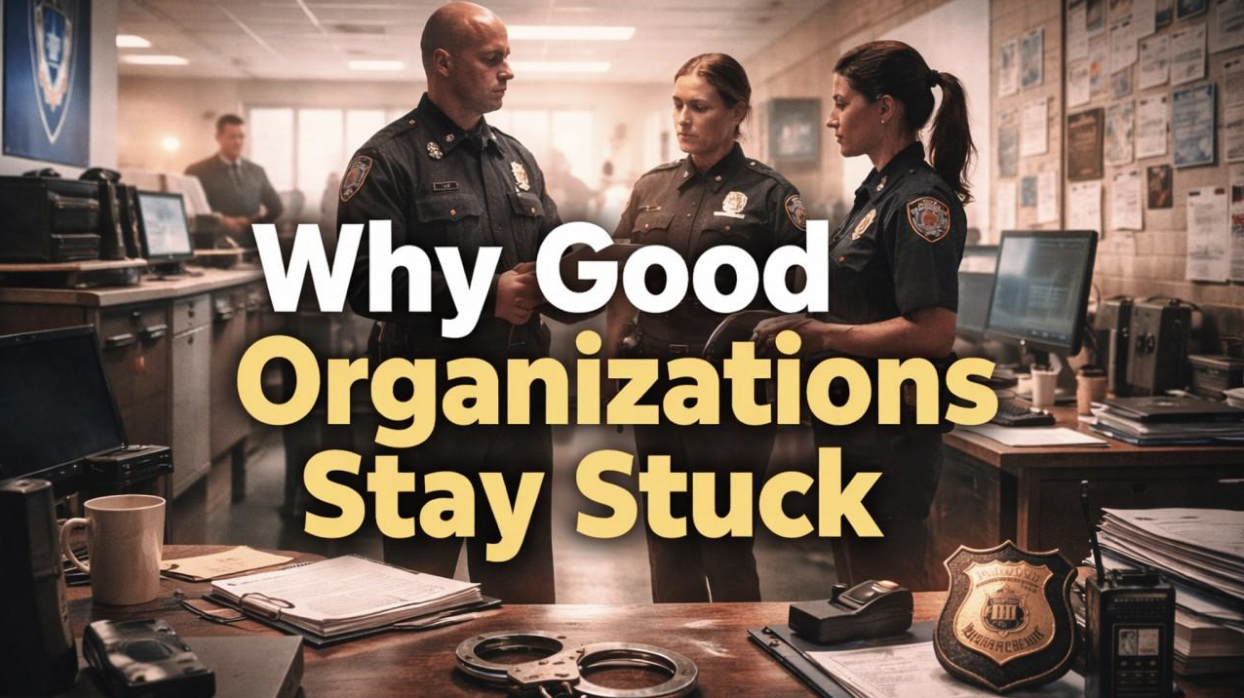
An organization full of good people. Talented people. People who care. And yet nothing changes.
The same problems show up year after year. The same conversations. The same frustrations. Leadership talks about improvement, but improvement never seems to stick.
If that sounds familiar, you’re not alone.
Over the past two years, as part of my graduate studies in Organizational Leadership, I’ve been studying law enforcement agencies of different sizes across the country. I wanted to understand why some organizations learn and adapt while others stay stuck.
What I found was clear. Some agencies excel because they build cultures where people grow, where feedback flows, where leaders model the change they expect. Others struggle, not because of bad people, but because of systems and patterns that quietly work against them.
The difference between the two taught me more about leadership than any textbook.
The Pattern Nobody Talks About
The organizations that struggled weren’t failing. They weren’t led by bad people. They weren’t short on talent or commitment.
But they were struck.
The very structures designed to create stability had become barriers to growth. The same things that made them reliable were not making them rigid.
Here’s what it looked like:
- They solved the same problems over and over, but never asked why the problems kept returning.
- They talked about innovation but rewarded compliance.
- They posted values on the wall, then made decisions that contradicted them.
- They wondered why employees left but never asked what they actually needed.
Researchers call this the gap between what we say we believe and what our systems actually do. Organizations talk about one thing. Their systems reward another. And over time, people stop believing the words on the wall.
The hard truth?
Good intentions don’t fix broken systems.
Three Things That Keep Good Organizations Stuck
- They treat symptoms instead of systems.
When staffing gets tight, they offer overtime and hiring bonuses. When morale drops, they plan an appreciation lunch. When turnover spikes, they blame the generation.
None of that is wrong. But none of it asks the harder question: what’s causing this in the first place?
I’ve seen this pattern repeat across agencies of all sizes. Leaders see a problem and reach for the fastest fix. It feels productive. It looks like action. But six months later, the same problem comes back wearing a different outfit.
The struggling agencies I studied knew external pressures were real. Budget constraints. Legislative mandates. A public perception problem across their entire profession. But internally, they kept applying surface-level fixes to system-level problems.
Real learning organizations don’t just analyze complexity. They act on it. They follow the thread from symptom to root cause, even when the root cause is uncomfortable.
- Their structure makes development impossible.
Research on mentoring suggests supervisors need a ratio of around 1:7 to meaningfully invest in their people. Many of the agencies I studied were running closer to 1:15.
At that ratio, supervisors aren’t developers. They’re air traffic controllers. They manage workload, put out fires, and hope nothing crashes. There’s no time left for actual growth.
And here’s the part nobody wants to say out loud: you can’t blame supervisors for not mentoring when the structure made it impossible from the start.
Organizations that stay stuck talk about development but don’t create the conditions for it. They expect leaders to grow people in margins that don’t exist. Then they wonder why their people feel unseen.
- They protect assumptions instead of questioning them.
Every organization has mental models. Deeply held beliefs about how things should work, who gets a voice, and what success looks like.
In healthy organizations, those assumptions get examined. In stuck organizations, they get defended.
“We’ve always done it this way.”
That phrase isn’t spoken by bad people. It’s spoken by tired people protecting what’s familiar. But every assumption you protect without questioning becomes a wall between your organization and the change it needs.
In several of the struggling agencies I observed, the systems rewarded people who followed established policy. They didn’t reward people who asked whether the policy still made sense. Over time, that system trained people to stop offering what they actually thought.
The best ideas in the building went unspoken. Because speaking up felt risky. And staying quiet felt safe.
What Separates Organizations That Learn
The difference isn’t resources. It’s not talent. It’s not even leadership intelligence.
It’s willingness.
Willingness to look at systems instead of symptoms.
Willingness to restructure so development can actually happen.
Willingness to question long-held assumptions, especially the ones that feel sacred.
The struggling agencies I studied had sophisticated leaders. They understood complexity. They could analyze problems with precision.
But analysis without action is just observation.
And observation without change is just watching yourself stay stuck.
What Thriving Organizations Do Differently
Not every organization stays trapped. Through my research and consulting work, I’ve also seen what thriving looks like.
In one agency, supervisors openly discussed impostor syndrome during a leadership session, the quiet fear most leaders carry but never name. They talked about feeling unprepared. About doubting themselves. About wondering if they belonged in the room.
That kind of honesty doesn’t happen in stuck organizations.
It happens when leaders create safety. When they model vulnerability. When they go first.
After the session, the chief of that agency shared feedback that stayed with me: “If I’m asking my people to grow, I need to be doing the same.”
That single sentence captures the difference between organizations that stay stuck and organizations that learn.
Stuck organizations demand growth from others while protecting themselves from change.
Learning organizations start with the leader in the mirror.
The Way Forward
Becoming a learning organization isn’t a training program. It’s not a retreat or a new mission statement.
It’s a commitment to building cultures where people can question, experiment, fail, and grow. Where feedback flows in every direction. Where the chain of command doesn’t silence the voices that see what leadership might be missing.
That kind of culture doesn’t happen by accident. It happens when leaders decide that growth matters more than comfort. That learning matters more than looking like you already have the answers.
The organizations that thrive in the next decade won’t be the ones with the most resources. They’ll be the ones who learned how to learn.
The ones that got unstuck.
Your systems are either building the culture you want or protecting the one you have. There is no neutral.
About the Author
Matt Davis is a leadership consultant specializing in transforming organizational trust into high-performance outcomes. Drawing from his experience in law enforcement leadership and ongoing research in transformational leadership theory, Matt helps organizations build cultures where people thrive. He is currently completing his Master of Science in Organizational Leadership at the University of Denver.
© 2026 Matt Davis. All rights reserved.